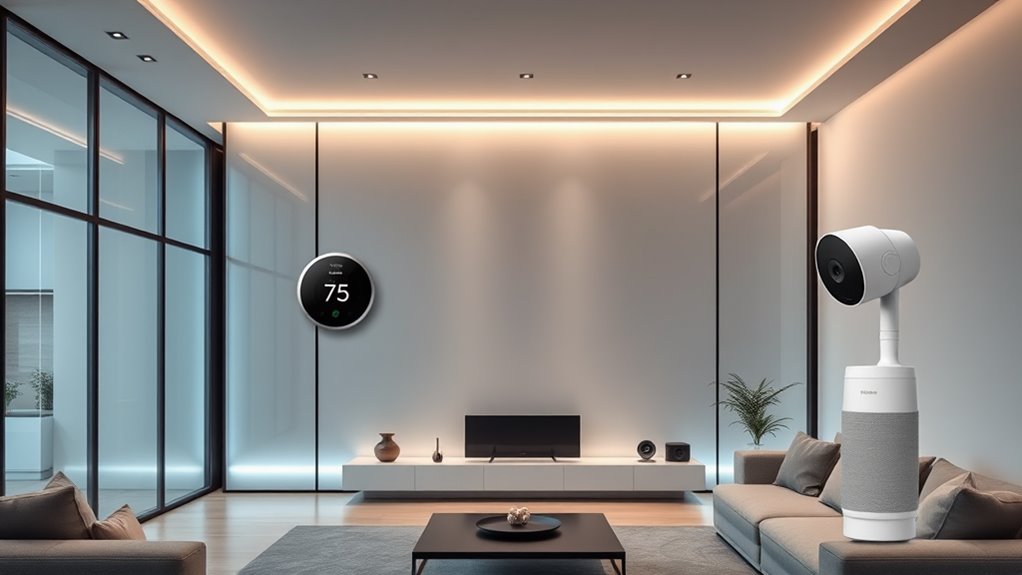
The Latest Innovations in Smart Home Devices
The latest innovations in smart home devices include advanced smart thermostats, integrated home security systems, and voice-controlled devices. These devices improve home efficiency, security, and convenience. Automated lighting systems and intelligent appliances likewise play an essential role in home automation. Smart home hubs integrate various devices for seamless control. As technology continues to evolve, smart home devices are becoming increasingly interconnected, leading to a more efficient and secure living environment, and there is more to explore in the swiftly advancing field of smart home innovations. Developers are constantly building smart home gadgets that offer enhanced customization and user-friendly interfaces. These innovations enable homeowners to control multiple aspects of their homes remotely, from adjusting climate settings to monitoring security cameras in real time. As artificial intelligence and machine learning advance, smart home technology will become even more intuitive and responsive to user needs.
Smart Thermostats
Implementing smart thermostats in a home can greatly improve the overall efficiency and comfort of the living space. These advanced devices offer a range of features that enable homeowners to exert control over their energy consumption, maximizing their energy and minimizing waste. With energy monitoring capabilities, smart thermostats provide detailed insights into energy usage patterns, allowing homeowners to identify areas for improvement and make data-driven decisions to optimize their energy efficiency.
Smart thermostats furthermore offer remote access, enabling homeowners to control their thermostat settings from anywhere, at any time. This feature is particularly useful for individuals with busy schedules, as it allows them to adjust their thermostat settings remotely, ensuring that their home is always at a comfortable temperature when they arrive. In addition, remote access enables homeowners to respond quickly to changes in their schedule, such as an unexpected trip or a change in work hours, by adjusting their thermostat settings accordingly.
Home Security Systems
Home security systems are an essential aspect of smart home devices, providing homeowners with an added layer of protection and peace of mind. Alarm systems, which can be integrated with other smart devices, are a vital component of home security systems, offering real-time alerts and notifications in the event of a potential breach. The use of video surveillance, in conjunction with alarm systems, enables thorough monitoring and recording of home premises, allowing for swift response to security threats.
Alarm Systems
Several key components comprise an extensive smart home setup, and among these, alarm systems, likewise known as home security systems, play a crucial role in safeguarding properties and occupants. These systems utilize smart alerts and remote monitoring to guarantee timely responses to potential threats. With the ability to monitor and control alarm systems remotely, homeowners can enjoy improved security and peace of mind.
| Feature | Description |
|---|---|
| Motion Detection | Triggers alerts when motion is detected |
| Smart Alerts | Sends notifications to homeowners in case of suspicious activity |
| Remote Monitoring | Allows homeowners to monitor their property from anywhere |
| Automated Responses | Automatically contacts authorities in emergency situations |
Video Surveillance
A well-designed video surveillance system serves as a cornerstone of modern home security systems, providing a visual deterrent to potential intruders and enabling homeowners to monitor their property in real-time. This advanced technology grants homeowners with unparalleled control and visibility, allowing them to respond swiftly to potential threats. With the integration of facial recognition, video surveillance systems can identify and alert homeowners to unknown individuals, improving the overall security of their property.
- Remote monitoring capabilities enable homeowners to access live footage from anywhere
- Advanced analytics and alerts notify homeowners of suspicious activity
- Integration with other smart home devices improves overall security and automation
- High-resolution cameras provide crystal-clear footage, even in low-light conditions. By leveraging these state-of-the-art features, homeowners can experience a new level of influence and control over their home security, with remote monitoring and facial recognition capabilities at their fingertips.
Voice Controlled Devices
The integration of voice-controlled devices has transformed the smart home experience, with voice assist technology enabling users to control various aspects of their home with simple voice commands. Smart speakers, in particular, have become a central component of many smart home systems, providing a convenient interface for voice control and other functions. The combination of voice assist and smart speakers has changed the way people interact with their homes, offering a seamless and intuitive experience that improves comfort, convenience, and overall quality of life.
Voice Assist
Implementing voice-controlled devices in smart homes enables residents to manage various aspects of their living space efficiently, streamlining daily tasks and improving overall convenience. Voice recognition advancements have considerably enhanced the user interface improvement, allowing for seamless interactions between residents and their smart devices. This technology has become increasingly sophisticated, enabling devices to accurately interpret and respond to voice commands.
- Enhanced voice recognition capabilities for accurate command interpretation
- Integrated user interface improvement for intuitive device control
- Advanced natural language processing for complex command handling
- Personalized voice profiles for customized device interactions
The integration of voice assist technology in smart homes empowers residents with unparalleled control and flexibility, allowing them to effortlessly manage their living environment. By leveraging voice recognition advancements and user interface improvement, smart home devices can be controlled with precision and ease, eventually elevating the smart home experience.
Smart Speakers
How seamlessly smart speakers integrate into daily life is largely dependent on their ability to accurately interpret voice commands, thereby facilitating effortless control over various smart devices within a residence. This capability enables users to exert total control over their smart home ecosystem, streamlining daily routines and boosting overall efficiency. Smart speaker integration has become a pivotal aspect of modern smart homes, as it allows for seamless interaction with numerous devices, from lighting and thermostats to security systems and entertainment platforms.
The recent voice recognition advancements have considerably improved the smart speaker's ability to accurately comprehend complex voice commands, reducing errors and misinterpretations. This development has paved the way for more sophisticated smart speaker integration, empowering users to manage their smart homes with unprecedented ease and precision. By utilizing the strength of advanced voice recognition, smart speakers have become an indispensable component of the modern smart home, providing a centralized hub for effortless control and unmatched convenience.
Energy Efficient Solutions
Energy efficiency is a key consideration for homeowners looking to minimize their environmental impact and reduce utility bills, with smart home devices offering a range of innovative solutions. By integrating solar panels and energy storage systems, homeowners can greatly reduce their reliance on non-renewable energy sources. This not just helps to minimize their carbon footprint but additionally provides a cost-effective solution for meeting their energy needs. Smart home devices can optimize energy usage by learning a household's energy consumption patterns and adjusting energy output accordingly.
Some key features of energy efficient smart home devices include:
- Smart thermostats that learn and adapt to a household's temperature preferences
- Energy monitoring systems that provide real-time energy usage data
- Automated energy management systems that optimize energy storage and usage
- Integration with solar panels and energy storage systems to maximize renewable energy usage
Automated Lighting Systems
Smart home devices offer a wide range of automated solutions, and lighting systems are no exception, with advanced technologies that enable seamless control and optimization of a household's lighting needs. Automated lighting systems provide homeowners with the ability to exert total control over their lighting, allowing for personalized settings that cater to their unique preferences. With automated scheduling, homeowners can program their lighting to turn on and off at specific times, creating a sense of occupancy even when the house is empty, thereby improving security.
Automated lighting systems additionally enable the creation of mood lighting, which can greatly impact the ambiance of a room. By adjusting the color temperature and brightness of the lights, homeowners can create a variety of moods, from relaxing to energizing. This feature is particularly useful in homes with smart home theaters or game rooms, where the lighting can be adjusted to improve the overall experience. In addition, automated lighting systems can be integrated with other smart devices, allowing for a unified and streamlined control experience. By leveraging automated lighting systems, homeowners can experience unparalleled convenience, flexibility, and control over their lighting, finally elevating their living experience. With their advanced features and capabilities, automated lighting systems are an essential component of any smart home ecosystem.
Smart Home Hubs
Automated lighting systems are just one aspect of an all-inclusive smart home setup, and their effectiveness can be greatly improved by a central control mechanism. This is where smart home hubs come into play, serving as the brain of the operation and enabling seamless smart hub integration. By connecting various devices to a central hub, homeowners can exercise total control over their smart home ecosystem, streamlining daily routines and amplifying convenience.
Smart home hubs boast multi device compatibility, allowing them to interface with a wide range of devices, from thermostats and security cameras to door locks and entertainment systems. This compatibility enables a unified and intuitive control experience, granting homeowners unparalleled command over their domain. Key features of smart home hubs include:
- Centralized device management and control
- Automated scene creation and scheduling
- Voice assistant integration for hands-free control
- Remote access and monitoring capabilities
Intelligent Appliances
Within the domain of smart home technology, appliances have undergone a significant transformation, emerging as integral components of an interconnected ecosystem. This evolution has given rise to intelligent appliances that seamlessly integrate with other smart devices, providing unparalleled control and convenience. In the intelligent kitchen, appliances such as refrigerators, ovens, and dishwashers can be monitored and controlled remotely, allowing homeowners to optimize their daily routines.
The intelligent kitchen is not merely the area that has benefited from smart technology. Smart laundry systems, for instance, can detect fabric types, automatically adjust washing cycles, and even notify homeowners when a cycle is complete. These advancements have not solely simplified household chores but additionally enabled homeowners to manage their energy consumption more efficiently. With the ability to schedule appliance usage during off-peak hours, homeowners can reduce their energy bills and minimize their environmental footprint.
The integration of intelligent appliances with smart home hubs has further improved their functionality, enabling homeowners to access and control their appliances from a single interface. This level of control and automation has redefined the concept of convenience, empowering homeowners to take charge of their living spaces like never before. As smart home technology continues to advance, intelligent appliances will play an increasingly crucial role in shaping the future of home automation.
Frequently Asked Questions
What Is Smart Home Device Compatibility?
Smart home device compatibility refers to seamless device integration, ensuring effortless control and automation. Adherence to platform standards is essential, enabling harmonious interaction between devices. This compatibility empowers users, streamlining smart home management and maximizing efficiency, as well as providing a unified and intuitive experience, driven by standardized protocols and interoperability.
How Secure Is My Smart Home Data?
Like a fortress, your smart home data security is paramount. Addressing privacy concerns, robust data encryption safeguards your information. With advanced protocols in place, your data is shielded from unauthorized access, empowering you to wield control over your digital domain, and alleviating concerns about potential breaches, ensuring your smart home remains a secure and private sanctuary.
Can I Control Devices Remotely?
Controlling devices remotely is a key aspect of modern convenience. Through remote access and mobile apps, users can exert dominion over their devices from anywhere. With a few taps on a smartphone, individuals can command their devices to perform various functions, granting them unparalleled control and flexibility, and solidifying their position as the absolute authority over their digital domain.
Are Smart Devices Easy to Install?
Like a key fitting perfectly into a lock, seamless integration is essential. Regarding installation simplicity, smart devices boast an improved user experience, empowering individuals with effortless setup and control. Leveraging state-of-the-art technology, these devices prioritize installation simplicity, ensuring a streamlined user experience that opens up unparalleled command and dominance over one's domain.
Do Smart Devices Require Maintenance?
Regarding device upkeep, regular maintenance is vital. To guarantee peak performance and device longevity, follow important maintenance tips, such as software updates and cleaning. This proactive approach enables seamless operation, minimizing downtime and maximizing efficiency, thereby utilizing the full potential of smart technology and reinforcing its overall value. Effective maintenance yields significant benefits.