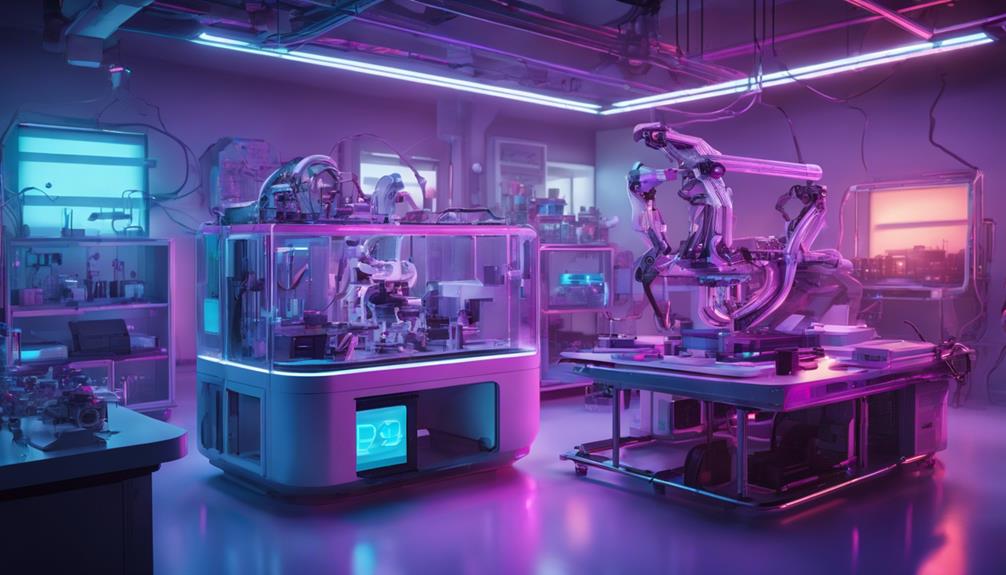
Transforming Ideas Into Reality With 3D Printing
You're on the cusp of bringing your innovative ideas to life, and 3D printing is about to become your most powerful accelerator. With rapid prototyping, you can quickly test and refine your ideas, democratizing innovation and accessibility. From aerospace to healthcare, 3D printing is transforming industries, enabling creative freedom and expression. Cost-effective production and manufacturing enable you to bring your visions to life. By breaking down traditional barriers, you're empowered to shape the future of manufacturing. As you explore the possibilities, you'll discover how 3D printing can propel your ideas into reality, and that's just the beginning of your transformative journey.
Rapid Prototyping Made Possible
With 3D printing, you can rapidly test and refine your ideas, creating up to 10 iterations of a prototype in the time it would take to develop just one traditional prototype. This game-changing technology empowers you to accelerate your design-to-production timeline, giving you a significant competitive edge. By leveraging 3D printing, you can effortlessly produce multiple design iterations, refine your model, and validate your concept in a fraction of the time and cost associated with traditional prototyping methods.
Through rapid prototyping, you can test and refine your design in real-time, making adjustments on the fly and iterating towards perfection. This iterative process allows you to identify and address potential design flaws, optimize performance, and fine-tune your product's aesthetics. With each successive iteration, you'll gain valuable insights into your design's strengths and weaknesses, enabling you to make data-driven decisions and drive innovation.
Democratizing Innovation and Accessibility
Your ideas are now more accessible than ever, thanks to 3D printing's ability to put innovative technology within reach of anyone with a creative vision. This democratization of innovation has broken down barriers, enabling individuals from diverse backgrounds to bring their concepts to life. With 3D printing, social equity is promoted as the playing field is leveled, and opportunities are opened up for underrepresented groups.
The global connectivity facilitated by 3D printing has connected creators worldwide, fostering collaboration and knowledge sharing. You can now tap into a vast network of innovators, engineers, and designers, leveraging their expertise to refine your ideas. This interconnectedness has given rise to a community that's driven by a shared passion for innovation.
You're no longer limited by geographical boundaries or financial constraints. With 3D printing, you can rapidly prototype, test, and refine your designs, regardless of your location or resources. This accessibility has empowered you to take control of your creative journey, turning your vision into a tangible reality.
As you navigate the world of 3D printing, you'll discover that the possibilities are endless. The fusion of innovative technology and global connectivity has created an ecosystem that's ripe for disruption. You're now poised to revolutionize industries, challenge the status quo, and create a lasting impact. The future belongs to those who dare to dream big, and with 3D printing, you hold the power to shape it.
3D Printing in Various Industries
As you bring your innovative ideas to life, you'll find that 3D printing's transformative power extends far beyond prototyping, revolutionizing industries from aerospace to healthcare, and every sector in between. You'll witness firsthand how 3D printing is redefining the manufacturing landscape, driving efficiency, and reducing costs.
In the aerospace industry, 3D printing is being used to create complex components, such as engine parts and satellite components, that are lighter, stronger, and more durable. This technology enables the production of complex geometries, reducing weight, and increasing fuel efficiency. The aerospace industry is just one example of how 3D printing is transforming traditional manufacturing.
In the medical field, 3D printing is being used to create custom Medical Implants, such as hip and knee replacements, that are tailored to individual patients' needs. This personalized approach enables faster recovery times and improved patient outcomes. Additionally, 3D printing is being used to create surgical models, allowing surgeons to practice and perfect complex procedures, reducing risks, and improving patient care.
As you explore the vast potential of 3D printing, you'll discover that its applications are virtually limitless. From aerospace applications to medical implants, 3D printing is transforming industries, and revolutionizing the way we live and work.
Unleashing Creative Freedom and Expression
By freeing designers and artists from the constraints of traditional manufacturing, 3D printing empowers you to bring even the most intricate and complex ideas to life. You're no longer bound by the limitations of traditional production methods, and you can finally release your full creative potential. With 3D printing, you can push the boundaries of design and artistic expression, exploring new forms, shapes, and structures that were previously impossible to produce.
You're free to experiment, innovate, and create without the burden of manufacturing constraints. Your imagination is the only limit to what you can achieve. You can create complex geometries, intricate patterns, and custom-made products that were previously impossible to produce. The design boundaries that once restricted your creativity are now a thing of the past.
3D printing gives you the power to turn your wildest ideas into reality. You can create functional prototypes, test your designs, and refine them quickly and efficiently. You can also produce limited-edition art pieces, bespoke jewelry, or custom-made products that showcase your unique style and vision. With 3D printing, you're in control, and your artistic expression knows no bounds. You're the master of your creative domain, and the possibilities are endless.
Cost-Effective Production and Manufacturing
With the creative freedom to design and produce unique items comes the added benefit of reducing production costs, allowing you to bring your innovative ideas to market at a lower expense. This is especially true when it comes to 3D printing, which enables you to produce complex geometries and customized products without the need for molds or tooling. This reduction in production costs is largely due to the economies of scale achieved through 3D printing, which allows you to produce small batches or even one-off products at a lower cost.
| Aspect | Traditional Manufacturing | 3D Printing |
|---|---|---|
| Production Volume | High volume required for cost-effectiveness | Low to no minimum order quantity |
| Material Waste | High material waste due to molding and tooling | Minimal material waste through additive process |
| Lead Time | Long lead times for mold creation and production | Rapid production and reduced lead times |
| Customization | Limited customization options | Unlimited customization possibilities |
As you can see from the table above, 3D printing offers significant cost savings and material efficiency compared to traditional manufacturing methods. By reducing material waste and producing only what's needed, you can minimize your environmental footprint while also saving on production costs. This allows you to allocate more resources to research and development, further accelerating your innovation pipeline. With 3D printing, you can bring your ideas to market faster and more cost-effectively, giving you a competitive edge in your industry.
Breaking Down Traditional Barriers
As you explore the possibilities of 3D printing, you'll discover that it's breaking down traditional barriers in ways that benefit you directly. By democratizing access to tools, reducing production costs, and streamlining supply chains, you'll find that the manufacturing process is more accessible and efficient than ever before. This newfound freedom is allowing innovators like you to turn their ideas into tangible products faster and more affordably.
Democratizing Access Tools
You now have the power to create complex designs and products that were previously inaccessible to anyone without extensive training or resources. With 3D printing, the playing field has been leveled, and the tools of innovation are now in your hands. This democratization of access has far-reaching implications, bridging the digital divide and empowering individuals and communities that were previously excluded.
Here are just a few examples of how 3D printing is breaking down traditional barriers:
- Community Outreach: Local libraries, schools, and community centers are now offering 3D printing services, making it possible for people of all ages and backgrounds to access cutting-edge technology.
- Accessibility: 3D printing has enabled the creation of customized prosthetics, assistive devices, and adaptive tools, improving the quality of life for individuals with disabilities.
- Education: Students can now design and print their own projects, fostering a deeper understanding of STEM concepts and developing essential skills for the future workforce.
- Entrepreneurship: With 3D printing, entrepreneurs can quickly prototype and iterate on their designs, reducing the time and cost associated with traditional manufacturing methods.
Reducing Production Costs
By putting production in your hands, 3D printing slashes costs associated with traditional manufacturing methods, freeing up resources for innovation and growth. You're no longer tied to expensive tooling, molding, and assembly lines. With 3D printing, you can produce small batches or one-off products at a fraction of the cost. This means you can experiment, test, and refine your ideas without breaking the bank.
As you scale up, 3D printing's economies of scale kick in, reducing costs even further. You can optimize resources by printing only what you need, when you need it, eliminating inventory costs and waste. This resource optimization also reduces the environmental impact of your production process.
With 3D printing, you're in control of your production costs. You can adjust your design, material, and production schedule to meet changing market demands. This flexibility gives you the power to respond quickly to customer needs, stay ahead of the competition, and drive business growth. By reducing production costs, you're free to focus on what matters most – creating innovative products that transform your industry.
Streamlining Supply Chains
Three-dimensional printing allows you to bypass traditional supply chain bottlenecks, eliminating the need for intermediaries and enabling direct access to production. This means you're no longer held back by lengthy lead times, inventory storage, and transportation costs. With 3D printing, you're in control of your supply chain, making it more agile and responsive to changing market demands.
Here are just a few ways 3D printing streamlines your supply chain:
- Reduced lead times: Produce parts and products on-demand, eliminating the need for lengthy production and shipping timelines.
- Increased logistics efficiency: Minimize transportation costs and reduce carbon emissions by producing locally and on-demand.
- Improved inventory management: Produce only what you need, when you need it, eliminating the need for inventory storage and reducing waste.
- Enhanced supply chain optimization: Make data-driven decisions with real-time production data, optimizing your supply chain for maximum efficiency.
Redefining the Future of Manufacturing
As the manufacturing landscape continues to evolve, 3D printing is poised to revolutionize traditional production methods, enabling companies to fabricate complex products with unprecedented speed and accuracy. You're at the forefront of this revolution, harnessing the power of additive manufacturing to reshape the very fabric of your industry.
The Industry Evolution is underway, and you’re driving the change. By embracing 3D printing, you’re not only streamlining production but also unleashing new possibilities for innovation. The Manufacturing Renaissance has begun, and you’re at the helm, guiding the transformation of your industry. With cutting-edge technology at your fingertips, you’re pushing boundaries and redefining what’s possible in manufacturing. From customized production to on-demand solutions, your forward-thinking approach is shaping the future. Beyond manufacturing, you’re also revolutionizing photography with AI, creating stunning visual content with unprecedented efficiency and creativity.
With 3D printing, you can produce complex geometries, reduce material waste, and accelerate time-to-market. You'll be able to create products that were previously impossible to manufacture, giving you a competitive edge in the market. The future of manufacturing is being rewritten, and you're holding the pen.
As you navigate this new landscape, you'll be able to respond to changing customer demands with unprecedented agility. You'll be able to produce customized products on demand, reducing inventory and logistics costs. The possibilities are endless, and the future is yours to shape. So, what will you create today?
Frequently Asked Questions
Can 3D Printing Be Used for Large-Scale Commercial Production?
Imagine walking into a factory where rows of 3D printers hum along, producing parts and products at an unprecedented scale. You're wondering if 3D printing can really handle large-scale commercial production. The answer is yes. With advanced production logistics and streamlined supply chains, 3D printing can efficiently produce high-volume orders. You can scale up production without sacrificing quality or efficiency, making it a game-changer for industries like aerospace, automotive, and healthcare.
How Do I Choose the Right 3D Printing Material for My Project?
When selecting the right 3D printing material for your project, you'll want to take into account the material properties that matter most. What's the desired strength, flexibility, and durability? Do you need it to be heat-resistant or waterproof? Make a list of your requirements and research materials that fit the bill. Don't compromise on your project's success – take the time to select the perfect material, and you'll be unstoppable.
Is 3D Printing Safe for Use in Medical Implants and Devices?
As you venture into the domain of medical implants and devices, you'll face a delicate frontier: is 3D printing safe for use in this sensitive sphere? Biocompatibility risks lurk, and regulatory hurdles loom large. You must meticulously consider the materials and manufacturing processes to guarantee the well-being of patients. One misstep could have devastating consequences.
Can I Use 3D Printing to Create Functional Electronic Components?
You're wondering if you can create functional electronic components using 3D printing. The answer is yes, you can! You can print circuits and create electronic prototypes with 3D printing technology. With printed circuits, you can test and refine your designs quickly and efficiently. This allows you to bring your innovative ideas to life faster, giving you a competitive edge.
Are 3D Printed Parts as Strong as Traditionally Manufactured Ones?
You're wondering if 3d printed parts can hold their own against traditionally manufactured ones. The answer's not a simple yes or no. It depends on the material and printing process used. Generally, 3d printed parts can be just as strong, but material fatigue can be a concern. To guarantee structural integrity, you'll need to choose the right material and printing technique. Don't worry, with the right combo, your 3d printed parts can be just as reliable as traditionally made ones.